
5 steps for creating a perfect marketing campaign
5 min
5 min
How to Create a Successful Marketing Campaign?
Here are the 5 steps for creating a perfect marketing campaign:
Step 1: Define Your Goal Clearly
Defining a goal is very 1st step of creating a successful marketing campaign. It’s like drawing a map before a road trip. If you don't know where you're going, you'll drive in circles and waste fuel. A marketing campaign without a clear goal works the same way, you spend money, make noise, and end up nowhere.
Why goals matter so much
Every decision in your campaign, what to say, where to say it, how much to spend, flows from your goal. When the goal is clear, decisions are easy. When it's fuzzy, every choice becomes a debate.
The difference between a weak goal and a strong one
A weak goal sounds like:
"I want more followers"
"I want to grow the brand"
"I want more sales"
These feel like goals, but they're actually just wishes. There's nothing to measure, no deadline, no way to know if you succeeded.
A strong goal sounds like:
"I want 300 new email subscribers in 45 days"
"I want to sell 150 units of Product X by the end of this month"
"I want to reduce the cost per lead from $12 to $8 within 60 days"
The difference is clear. Strong goals have a number, a deadline, and a clear definition of success.
Use the SMART framework
Choose your every goal with these parameters:
Specific: Exactly what do you want to happen?
Measurable: How will you track it?
Achievable: Is it realistic, given your budget and timeline?
Relevant: Does it actually move your business forward?
Time-bound: By when?
One campaign, one goal
Resist the temptation to bundle multiple goals into one campaign. "I want leads AND brand awareness AND more followers" is not a campaign; it's three campaigns squeezed into one, and it will confuse your audience and dilute your results. Pick one goal and build everything around it.
Also read: How to measure the ROI of paid advertising
Step 2: Know your Audience
This is the most skipped step in marketing, and the most expensive mistake you can make. When you try to talk to everyone, you connect with no one. The more precisely you understand your audience, the more powerfully your campaign will land.
Go deeper than basic demographics
Most marketers stop at age, gender, and location. That's the surface level. Real audience research goes much further:
What is the specific problem they wake up thinking about?
What have they already tried to solve it, and why did it fail?
What do they fear? What do they want to avoid?
What does success look like to them?
What words do they use when they describe this problem, in reviews, Reddit posts, comments, DMs?
That last point is critical. When you use your audience's own language in your campaign, it feels like you read their mind. That creates instant trust and attention.
Build a simple audience profile
Write out a one-paragraph description of your ideal customer as if they were a real person. Give them a name if it helps. Where do they work? What keeps them up at night? What would make their life easier? What do they scroll past, and what makes them stop?
This profile becomes your reference point for every piece of content you create.
Where to find this research
You don't have to guess. Look at:
Amazon reviews for similar products (people are brutally honest here)
Reddit threads in relevant subreddits
Comment sections on competitors' social posts
Customer support tickets, if you already have customers
Direct conversations: just ask real people
Step 3: Choose the Right Platform
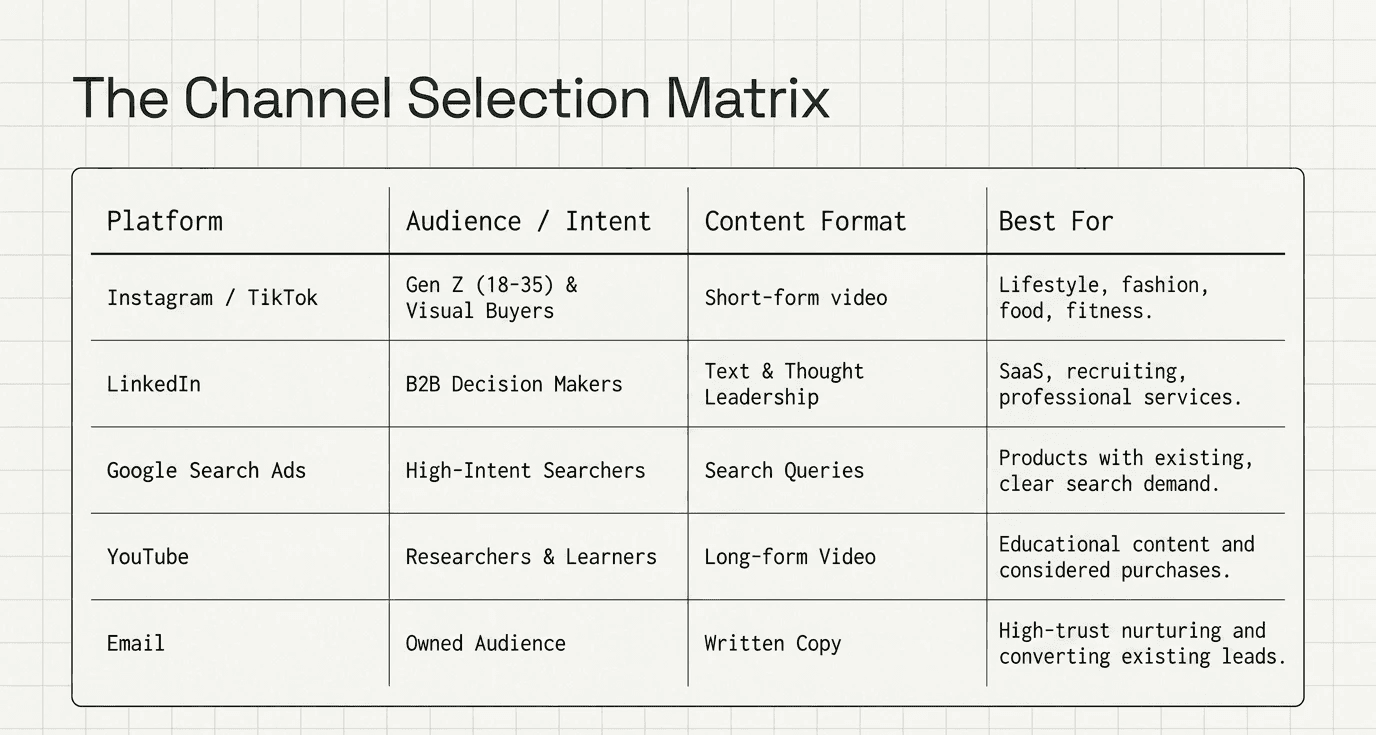
A brilliant message delivered on the wrong platform is wasted effort. Channel selection is not about where you like to hang out; it's about where your audience already is and where they're most likely to act.
The most common platforms and who they work for
Instagram and TikTok: visual products, lifestyle brands, fashion, food, fitness, and anything targeting the 18–35 demographic. Short-form video dominates here.
LinkedIn: B2B products, professional services, SaaS, recruiting, thought leadership. Decision-makers are here.
Google Search Ads: high-intent buyers. People are searching for a solution right now. Works well for products with clear search demand.
Email: owned audience, high trust, strong for nurturing and converting leads you already have.
YouTube: educational content, product reviews, long-form storytelling. Works especially well for considered purchases where people research before buying.
Facebook: still strong for older demographics (35+), local businesses, and retargeting campaigns.
Influencer / Creator channels: works when trust and social proof matter more than direct messaging.
How to choose the right platform?
Ask three questions:
Where does my target audience spend the most time?
Where do they go when they're ready to buy something like mine?
What content format (video, text, image, search) matches my message best?
The answers will point you toward two or three channels. Start there.
The one-channel rule for beginners
If you're new to paid campaigns or working with a tight budget, pick one channel and master it before expanding. It's far better to run an excellent campaign on one platform than a mediocre campaign on five. Depth beats breadth at the start.
Organic vs Paid
Organic (free content, SEO, social posts) builds long-term equity but takes time. Paid ads get you fast, targeted reach, but cost money and stop the moment you stop paying. The best campaigns combine both, paid to accelerate and organic to sustain.
Also Read: 4 great examples of UGC
Step 4: Create Your Message and Content
This is where strategy becomes something people actually see and read and feel. Everything you've done up to this point was preparation. Now you build.
Lead with the benefit, always
People don't care about your product. They care about what your product does for them. This distinction changes everything about how you write.
Feature-first (weak): "Our platform uses machine learning to analyze your data." Benefit-first (strong): "Find out exactly which posts are bringing you customers, in three clicks."
Every headline, every ad, every caption should answer one question from the reader's perspective: "What do I get out of this?"
The anatomy of a strong campaign message
A clear campaign message has three parts:
The hook: Grabs attention in the first second. A question, a bold claim, a surprising stat, a relatable problem.
The body: Explains the benefit, builds trust, and handles objections. This is where you connect your audience's pain to your solution.
The call to action (CTA): Tells them exactly what to do next. "Start your free trial." "Download the guide." "Book a call." Be specific; vague CTAs like "Learn more" get ignored.
Keep the message consistent
One of the biggest mistakes brands make is changing their tone and message across different pieces of content. Your Instagram ad, your email, your landing page, and your retargeting ad should all feel like they're from the same campaign. Same core message. Same tone. Same promise. Just adapted for each format.
This consistency builds recognition. When someone sees your ad three times across three platforms, and it feels cohesive, trust builds faster.
Creative formats that work
Video: highest engagement, especially short-form (under 60 seconds). Show the problem, show the solution, show the proof.
Carousels: great for breaking down a concept or showing before/after results.
Static image ads: work best with a strong visual and a short, punchy line of copy.
Long-form written content: articles, email sequences, and LinkedIn posts, best for building authority and nurturing leads over time.
Test multiple versions
Never go with just one version of your ad or message. Create two or three variations, different headlines, different visuals, different hooks, and let the data tell you which one works. This is called A/B testing, and it's one of the fastest ways to improve campaign performance.
Also read: 5 reasons why your video production sucks and how to fix it.
Step 5: Launch, Measure, and Improve
Most people launch and then check their follower count or like count and measure success or failure. That's the wrong way to measure a campaign. You need to track the numbers that connect directly to the goal you set in Step 1.
The metrics that actually matter
Match your metrics to your goal:
If your goal was leads: track cost per lead, lead volume, lead quality
If your goal was sales: track conversion rate, revenue generated, return on ad spend (ROAS)
If your goal was traffic: track clicks, click-through rate (CTR), bounce rate, time on page
If your goal was awareness: track reach, impressions, frequency
Give it time before you measure
This is where impatience kills campaigns. Most marketers pull the plug too early because they don't see results in the first 48 hours. In reality, platforms need time to learn your audience (especially with paid ads), and audiences need multiple touchpoints before they act.
As a general rule, give a campaign at least 7 to 14 days of live data before making major changes. For smaller budgets, it might take longer to gather statistically meaningful numbers.
The review cycle
Set a regular review schedule, weekly is usually ideal. In each review, ask:
Which ad, audience, or channel is performing best? Put more budget there.
Which one is underperforming? Pause it or test a new variation.
Is the cost per result going up or down over time? Why?
Are people clicking but not converting? The issue might be the landing page, not the ad.
The landing page problem
A common mistake is blaming a bad ad when the real problem is the page the ad sends people to. If your click-through rate is healthy but conversions are low, your landing page is probably the weak link. It should match your ad message exactly, load fast, have one clear CTA, and remove all distractions.
Iterate, don't restart
When something isn't working, most people scrap everything and start fresh. That's rarely necessary. Usually, only one element is broken — the headline, the audience targeting, the offer, or the landing page. Identify the weak link, fix it, and test again. This iterative approach saves time and budget.
Document what you learn
After every campaign, write down what worked and what didn't. This becomes your playbook. Over time, you'll build a library of insights specific to your brand and audience that no competitor can replicate, because it came from your real-world data, not a general best practice guide.
Conclusion
Here is how the five steps connect as one system:
A clear goal tells you what success looks like → Deep audience research tells you who you're speaking to → Right channel selection tells you where to reach them → Strong message and content tells them why they should care → Measurement and iteration make the whole thing better over time.
Skip any one of these steps, and the chain breaks. Follow all five consistently, and you have a campaign that doesn't just look good, it actually works. Still confused or dicey about your next campaign? No worries, visit Motion.labs and let us handle this.
FAQ
1. How much money do I need to start a marketing campaign?
There is no fixed number. You can start a basic campaign on Google or Meta with as little as $5 to $10 a day. What matters more than the total budget is how you allocate it. Start small, test two or three variations, find what works, and then scale the budget behind the winner. Throwing a large budget at an untested campaign is one of the fastest ways to waste money in marketing.
2. How long does it take to see results from a campaign?
It depends on the channel and the goal. Paid ads can start showing data within 24 to 48 hours, but meaningful results usually take 7 to 14 days. SEO and organic content take much longer, sometimes 3 to 6 months, before you see significant traffic. If you need fast results, paid channels are the way to go. If you're building for the long term, combine both.
3. Do I need to be on every social media platform?
No, and trying to be everywhere usually hurts more than it helps. Each platform requires a different content style, posting frequency, and audience approach. Spreading yourself thin across six platforms means doing all of them poorly. Pick one or two platforms where your target audience is most active, do those really well, and expand only once you've built a system that works.
4. How do I know if my campaign was actually successful?
Go back to the goal you set at the start. If your goal was 200 leads and you got 200 leads, the campaign succeeded. If you got 80, it didn't, but you still learned something valuable. Success in marketing is always measured against a specific, pre-defined goal, not against a feeling or a general sense that things went well. Campaigns without clear goals have no real definition of success, which is why Step 1 is the most important step of all.
Give us a call
Related Blogs
SaaS Video Editor Jobs in San Francisco: What to Know Before You Apply
GPT-6 Astra and California tech hiring: what employers should change in 2026
Digital marketing jobs in the USA for freshers: roles, salaries, and how to actually get hired
Best AI Hiring Agency in the US: How to Choose the Right Partner in 2026
Claude AI as a Job Search Agent: What It Can (and Can't) Do for Job Seekers in the USA
Junior backend developer jobs in San Francisco: where to look and how to get hired
Top 10 IT Recruitment Agencies in California (2026)
WordPress developer jobs in the US: how hiring agencies actually fill them
AI UGC Video Editor Hiring Agency in San Francisco | TheFutureJobs
Content marketing jobs in Texas and New York: what hiring agencies are actually filling in 2026

Team
Legal
Privacy Policy
Legal & Rights